


Career Coaching vs. Therapy: The Differences Explored
- Meike Hennon

- Jun 17
- 9 min read

If you’ve ever found yourself searching "career coaching vs. therapy" late at night, trying to figure out which one you actually need, you’re in good company. The lines between the two can feel very unclear, especially when what’s holding you back at work feels deeply personal too.
The good news is that more people are giving themselves permission to say "I'm not okay" — and meaning it. Whether it's burnout, restlessness, or just a nagging feeling that something needs to change, those feelings are valid. And they're worth paying attention to.
Today, the real question sounds more like ‘which kind of support is the right fit for me, where I am right now, and what I want to achieve?’, and this blog has been written to help you answer that question by comparing career coaching vs. therapy. At Shinebright we want to help you understand what the difference is and how to choose what is right for you, because we are deeply committed to helping you get the support you need.
The best way to start is by clearly defining both disciplines, so that’s what we’ll cover next…
What Is a Career Coach?
A career coach is a professional who partners with you to help you get clarity on your strengths, define your direction, and build the momentum you need to move forward. The work is rooted in the present and the future. The focus is on where you are now, where you want to be, and what it is going to take to get there with purpose and confidence.
Career coaches typically work with professionals who feel stuck, burnt out, or just unsure of what their next step should be. If something feels off but you can’t quite name it yet, a career coach can help you slow down for a moment to figure that out, and then help you do something about it through getting to know yourself and how you operate.

Good career coaching asks relevant, meaningful questions. It involves genuine listening and understanding on both sides. It should help you build a real, actionable plan for the steps to come that’s built around your actual life, wants and circumstances, not something taken from a generic playbook. Career coaches help you connect the dots between who you are and the kinds of work that would actually fulfill you, and at Shinebright, our coaches are also certified to use the CliftonStrengths assessment by Gallup, which gives your self-discovery process a structured, evidence-based foundation.
Unlike therapy, career coaching doesn't have one universal standard for certification, so credentials can look pretty different from coach to coach. That said, you can look for coaches with credentials, backgrounds or qualifications in related fields. As an example, at Shinebright one of our coaches has a Master’s in Organizational Development, the other has a background in degree-level teaching. They combine their knowledge from those two backgrounds, and blend it with nearly 30 years of coaching experience to support today’s Shinebright clients.
What Is a Therapist?
A therapist is a licensed mental health professional trained to help people process emotional pain, psychological patterns, and the experiences that shape how they think, feel, and behave.
Therapists can work with people who are navigating a wide range of mental health challenges.For example, anxiety, depression, trauma, grief, relationship difficulties, or major life transitions. If what you are carrying feels deeply rooted in your emotional or psychological world, a therapist is specifically equipped to support you through it.

The skills a therapist brings include extensive clinical training, empathy, and evidence-based techniques such as Cognitive Behavioral Therapy (CBT) or psychodynamic approaches. They are trained to identify and address mental health conditions in ways that fall entirely outside the scope of career coaching.
Therapy is open-ended and reflective, it's built around conversation, processing emotions, and uncovering patterns over time. The progress can be gradual and is certainly nonlinear, and that's completely okay. That's exactly how that work is supposed to go.
Therapists will also hold state-licensed credentials such as Licensed Clinical Social Worker (LCSW), Licensed Professional Counselor (LPC), Licensed Marriage and Family Therapist (LMFT), or doctoral-level qualifications such as Psy.D. or Ph.D. in psychology. These are regulated designations, and require a lot of supervised clinical training to earn.
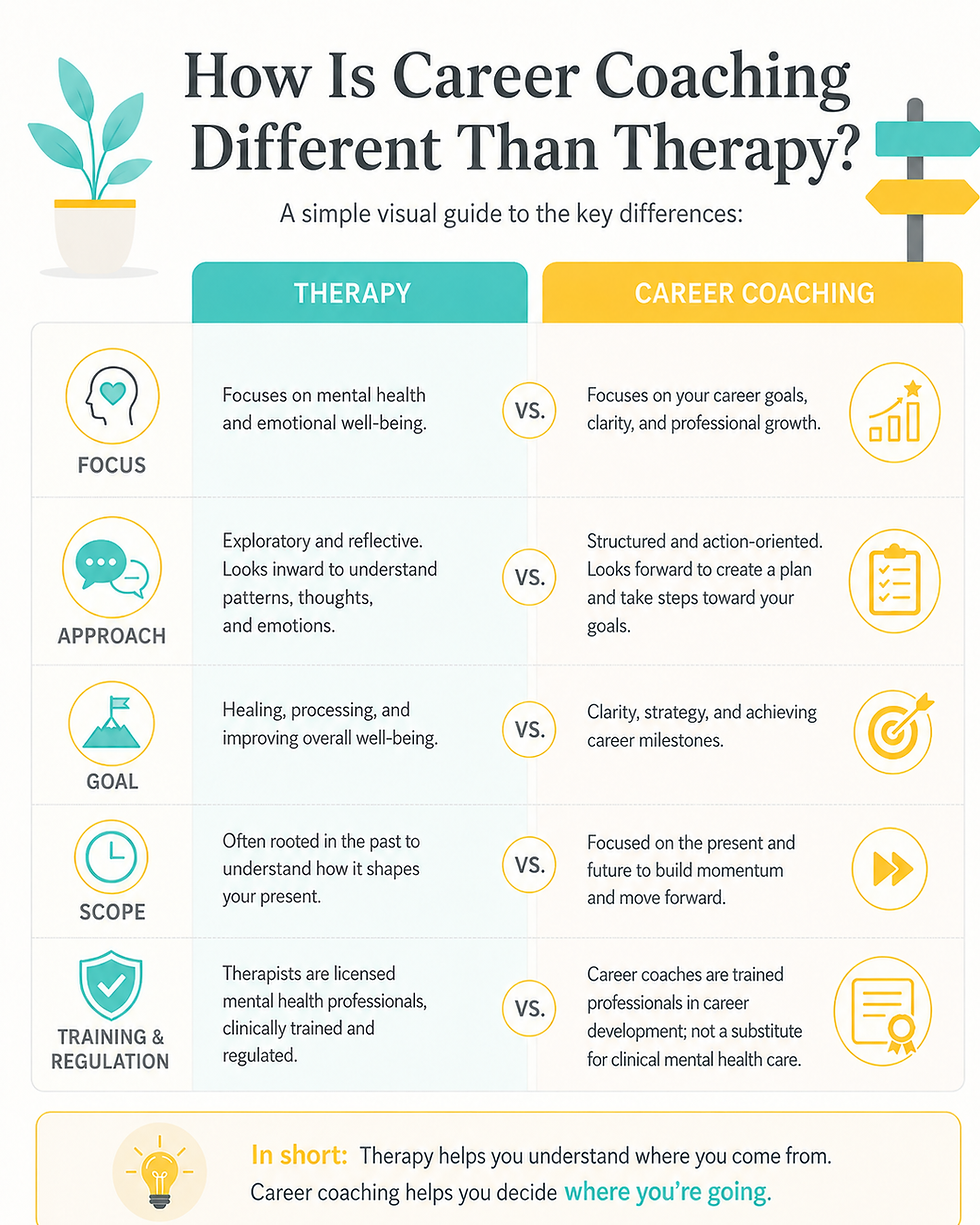
How Is Career Coaching Different Than Therapy?
The simplest way to put it is that:
A therapist is clinically trained to help you heal, processing the past, understanding patterns, and treating mental health.
A career coach is trained to help you move forward, getting clear on your goals, recognizing your strengths, and building a real plan to get where you want to go.
Coaching vs. therapy also differs in how sessions are structured:
Therapy tends to be open-ended and exploratory.
Coaching is structured, goal-oriented, and action-focused.
And to be clear, one isn't better than the other, and honestly, many people benefit from both at different points in their lives. The two disciplines just serve different purposes, and are designed to do different things. The goal isn't to choose which one is more valuable, it's to understand which one is the right fit for where you are and what you need right now.
The coach vs. therapist distinction also matters in terms of professional regulation:
Therapy is a licensed, closely regulated profession.
Career coaching, while it can involve meaningful personal reflection and change, is not a clinical mental health service, and importantly, is not a substitute for one.
The times of your life that each discipline deals with can be different too:
Therapy often looks inward and backward, exploring how your history influences your present.
Career coaching looks forward, exploring and defining what you want your working future to look like.
So, a therapist helps you understand and work through where you have been, and a career coach helps you figure out where you are going in your career, and gives you the clarity, structure, and momentum to get there. When you are weighing career coaching vs. therapy, understanding that difference is key to understanding how career coaching is different from therapy.
Do I Need a Therapist or a Career Coach?
Now that you have explored what both a therapist and career coach are ‘by definition’, it’s only natural to ask “Okay, do I need a therapist or a career coach then?” Hopefully the section above covering how career coaching is different from therapy will help you to answer that question, but if you need a little extra direction and support (and if you do, that’s totally okay), then here are some telltale signs that career coaching may be especially helpful for you right now:
You feel stuck or stagnant in your current role but you’re not sure why, or what to do about it.
You are thinking about a career transition or career pivot but feel overwhelmed, or don’t know where to begin.
You know something needs to change, but can’t picture what a fulfilling career would actually look like yet.
You feel capable and competent at your job, but feel like you might not be in the right role or on the right path.
You want structure, accountability, and a clear plan to move forward with confidence.
You are ready to invest in meaningful career growth and stop drifting.
If you're wondering whether therapy might be the right fit for you, that's honestly a great question — just not one we're qualified to answer. We're coaches, not therapists, so we're not the right people to weigh in on that. What we'd suggest is bringing that question to your doctor. They'll be able to point you in the right direction and help you figure out what kind of support makes the most sense for where you are right now.
And however you’re feeling about comparing therapy vs. coaching for career struggles, don’t forget that a career coach and therapist can absolutely work in parallel, and can actually complement each other well. So don’t feel like you have to choose if both feel like they could be beneficial to you.
What Benefits Can I Expect from Career Coaching?
When you invest in yourself through career coaching, here are some of the benefits that you can expect to see.
Accountability, motivation, and support
When you work with a coach, you're not figuring it out alone anymore. A good coach provides the structure and process to keep you moving — holding you accountable, keeping you motivated when energy dips, and showing up consistently through every part of the journey. That kind of steady support? It changes things.
Structure and goals
If you’re not sure where to start or how to define what you actually want, that’s ok. Helping you get clarity on what you want to achieve, and how you’re going to get there is part of what the coaching process is designed for. Together, you and your coach will build a clear set of goals and a structured plan to reach them as part of the coaching process.
Maintained momentum
Career transitions take time, and it is easy to feel overwhelmed. By offering accountability, encouragement, and goals that act like milestones on your journey, coaching keeps your sense of progress and momentum alive, and gives you the direction to stay on track even when things feel uncertain.
Meaningful feedback with actionable insights
You will receive feedback that is honest, thoughtful, personalized, and specific. We’ll give you informed advice that’s tailored to you, and that actually helps you make progress.
Better, more informed career decisions
We believe that a strong sense of self-awareness is behind every great career move. Coaching helps you know yourself better, help you recognize your natural strengths, and become your own best advocate. When you understand who you are and what you bring, you make decisions that are genuinely aligned with what you want.
And beyond the practical outcomes, don’t underestimate the intangible ones: the personal growth, the clarity, the relationships you build through the process, and the experience of finally being able to picture what it is going to feel like to be in a role that truly fits.

FAQs About Career Coaching with Shinebright
Who is career coaching by Shinebright for?
Shinebright works with all kinds of people, from recent graduates looking to make the right opening moves towards a satisfying career, to professionals who have been in the workforce for a while and are feeling stuck or unfulfilled, to seasoned professionals ready for something different from ‘career 2.0’. Whether you are considering a career transition, working towards the next level in your career, or simply trying to figure out what ‘a career that truly fits’ would look like for you, our coaching is designed to meet you exactly where you are.
What is your approach to coaching?
Our approach is holistic and strengths-based. We use a structured, three-phase process that begins with self-discovery and strengths exploration, moves into defining your career direction, and then builds out a practical strategy and roadmap for getting you to where you want to be. We use the CliftonStrengths assessment by Gallup as a foundation, because we believe that when people take the time to slow down for a moment and develop genuine self-awareness, they are then able to take the next steps in their professional journey with more accuracy, confidence, and success. Learn more about our full process on our one-on-one coaching page.
Can you tell me more about your coaches?
Shinebright is a woman-owned business with 14 years of experience supporting professionals through meaningful career growth. Our founders bring backgrounds in education and Organizational Development, and that expertise shapes the depth, structure, and quality of every coaching program we offer. You can read more about the people behind the process on the ‘our coaches’ page.
Do you offer any services beyond career coaching?
Yes. In addition to one-on-one career coaching, we offer career development services, executive and leadership coaching, and professional resume writing services. In fact, the truth is that we see resume writing as something of an art form, so we’ve worked hard to make sure that our dedicated in-house resume writing experts are the very best in their field… Masters of their craft who know how to tell your story in a way that opens doors.
Can I get more details on your coaching packages and pricing?
Our one-on-one coaching packages are structured to give you personalized support, strategy, and momentum. Package One includes 10 coaching sessions plus Shinebright Membership at $2,495. Package Two includes 15 sessions, a brand new resume, and Shinebright Membership at $3,560. The best next step is to reach out and schedule a consultation so we can talk through which option makes the most sense for where you are and where you want to go.
What’s the situation regarding medical insurance coverage?
Therapy provided by a licensed mental health professional is typically covered by medical insurance, though finding an in-network provider who is accepting new patients can be a challenge. On the other hand, career coaching generally isn’t covered by health insurance. Instead it’s an investment you make directly in your professional development. If you have questions about what your insurance will cover, our advice is to check directly with your insurance provider. And if you are curious about what coaching with Shinebright would look like for you, we are always happy to talk it through. When you are comparing career coaching vs. therapy in terms of access and cost, it is worth having a full picture of both sides.


